Google Shopping and AI Mode barely overlap

On September 24, 2026, Common Thread Collective, an agency that works with ecommerce stores, broke down a study by the company Productrise. The finding: only 1.28% of products from Google's regular product carousel also appeared in AI Mode for the same query on the same day. Your position in Google Shopping says almost nothing about whether the AI results will show you. Below I look at where this gap comes from, how to calculate your own missing visibility, and what to change in your feed before the November sales peak.
What AI Mode is and how its product results differ from the carousel
AI Mode is a Google Search mode where, instead of a list of links, the Gemini model answers. Ask about a product and it builds an answer with a few cards showing price and seller. The regular Google Shopping carousel, the familiar strip of products above the search results, works differently: it's a long row you can scroll through.
Both draw on the Shopping Graph, Google's shared database of products, prices, and sellers. Google confirmed this itself. It also confirmed that the two surfaces use different selection logic. The company did not verify the study's numbers and has not published any separate guidance for AI Mode.
How the data was collected: 2,000,000 products over 23 days
Before trusting the percentage, I opened the methodology. Productrise collected more than 2,000,000 product listings across more than 100,000 results pages. The markets were the US and the UK, and the period ran from August 9 to August 31, 2026, so 23 days. For each query, the two result sets were compared on the same day, so seasonality and price changes barely affect the outcome.
The sample is large, but it has limits worth remembering. These are English-speaking markets. If you sell there through Merchant Center, Google's dashboard for uploading a product feed, the data describes your market directly. Numbers may differ in other countries, but the underlying mechanism is the same.
Why AI Mode has 7 times fewer spots
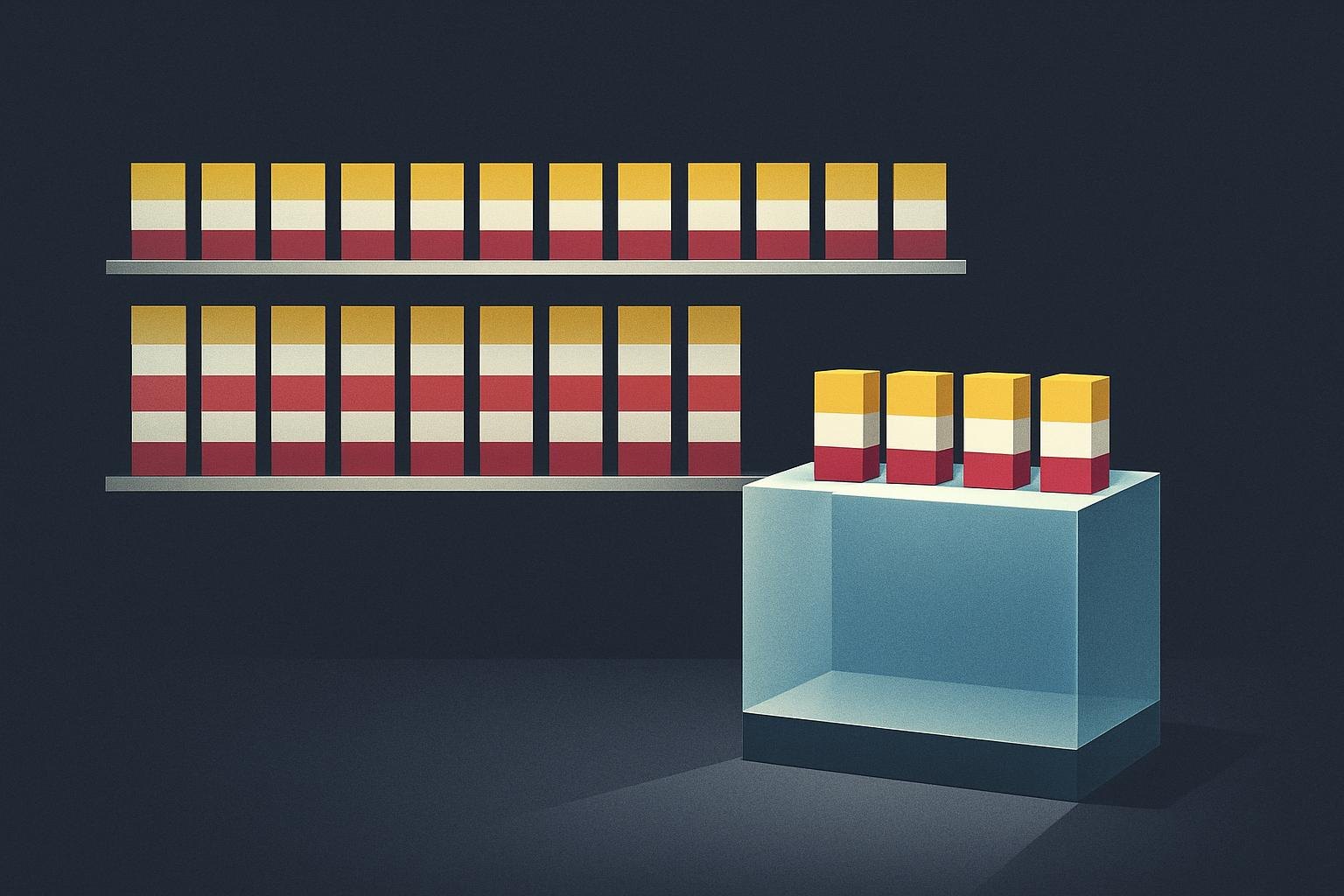
On average, the Google Shopping carousel shows 27.8 products per query, while AI Mode shows 3.9. Dividing one by the other gives 7.1: for every spot in the AI results there are 7 in the carousel. That difference alone explains part of the problem, but not all of it. If AI Mode simply took the top 4 products from the carousel, the overlap would be about 14%, not 1.28%.
So the issue isn't a shortened list, it's a different selection. You can translate 1.28% into plain terms: out of 78 products you see in the carousel, roughly 1 makes it into AI Mode for the same query.
The psychology of choice helps me here. The carousel is like a supermarket shelf: a person scans 28 options on their own, and whoever is most visible wins. AI Mode is like a sales assistant who gets asked a question and names 4 options. The assistant doesn't pick by shelf position but by how well the product answers the question. That's why the two surfaces have different leaders.
The seller and price in AI Mode are often different
Even if a product appears in both, that doesn't mean the sale goes to you. The top seller differs in 49.6% of those cases, so roughly every other time. Same model, same sneakers, but in AI Mode a different store comes first.
Prices tell a similar story. The price differs for 38.1% of matching products, and in 68.4% of those cases it's higher in AI Mode. Multiplying: 0.381 x 0.684 = 0.26. For roughly a quarter of matching products, the AI results show a higher price than the carousel.
When AI Mode shows a higher price, the median difference is 22.2%. The mean in the study is 88.5%, but a few extreme outliers pull it up, and the Common Thread Collective tracker summary lists the mean as 21.6%. So I rely on the median. If you sell cheaper but AI Mode shows a pricier competitor, the shopper won't see your price.
How to calculate your missing visibility
The easiest way is through share of results. Take an example from the study: a brand has 3 listings in a carousel of 27.8. Dividing 3 by 27.8 gives 10.8%, or about 11% of the results. To hold the same share in AI Mode, you'd need 0.108 x 3.9 = 0.42 of a spot, less than half a slot.
There's no such thing as half a slot. For each query, a brand either takes 1 of roughly 4 spots or isn't in those results at all. That's why the familiar metric "how many listings do I have in Shopping" doesn't work for AI Mode. What you need to count is something else: for what share of your key queries you appear at all.
Here's how I set up this check. A spreadsheet with your 20 to 30 main queries, one row per query. Columns: is the product in the carousel, is it in AI Mode, who is the top seller in each, what's the price in each. I check everything on the same day so prices don't have time to change. The share of rows with "yes" in the AI Mode column is your visibility.
Since September 16, 2026, you don't have to do this only by hand. In the US, Canada, Australia, India, and New Zealand, AI Performance Insights became available to everyone: a Google report on a brand's share of presence in AI Mode and AI Overviews, the AI answers above the regular results. If you sell in these countries, start with that report and use the manual spreadsheet for markets where it isn't available.
Why this is urgent: 4 Google changes in September
The gap between the two surfaces would just be an interesting statistic if ads and checkout hadn't arrived in AI Mode. In one month, Google changed several things at once.
- August 31product ads in AI Mode answers
- September 1automatic migration of campaigns to AI Max
- September 9exact and phrase match keywords shown in AI Mode
- September 16conversational attributes in Merchant Center
- September 22checkout inside AI Mode for Shopify
- August 31, 2026. Google confirmed that product ads appear as a carousel directly inside AI Mode answers. Gemini selects the products for them from the Merchant Center feed. According to the same summary, AI Mode has more than 1,000,000,000 monthly users, and 74% of shoppers search for products with AI.
- September 1, 2026. Google is automatically moving eligible search campaigns to AI Max, a mode where the system expands queries and assembles ads on its own. According to Google, this delivers an average of +7% conversions and up to +27% for campaigns on exact and phrase match. This is the company's own claim, not an independent assessment.
- September 9, 2026. Exact and phrase match keywords in regular search campaigns can now show text ads in AI Mode for direct queries like "buy running shoes." For conversational queries, where a person describes the whole situation, you still need AI Max or Performance Max.
- September 22, 2026. Google automatically enrolled eligible Shopify stores in checkout inside AI Mode and Gemini through Google Pay. The shopper pays without going to the store's website. You can only turn it off manually: Shopify admin, then Sales channels, then Agentic.
AI Mode used to only suggest what to buy. Now you can see ads and pay there too. About a month remains until the November sales peak, and in that time a surface where you're absent 98.72% of the time is becoming a checkout counter.
What to change in your Merchant Center feed now
Since Gemini picks products from the feed and Google hasn't given any AI Mode guidance, we work with what's confirmed.
- Fill in conversational attributes. Since September 16, 2026, Merchant Center has conversational product attributes, fields that describe a product in the words people use when asking a question: what it's for, who it suits, in what situation. In lululemon's tests, these attributes appeared in 50% of AI Mode recommendations.
- Compare your prices with competitors in AI Mode. For roughly a quarter of matching products, the AI results show a higher price than the carousel. Check which price and which seller a shopper sees for your 20 main queries.
- Update your images. By January 31, 2027, all product images in Merchant Center must be at least 500 by 500 pixels, with 1,500 by 1,500 recommended. Products with smaller images will be disapproved. Better to replace them before November than in January.
- Decide about Shopify checkout. If your store is on Shopify, you're already enrolled in checkout inside AI Mode. Make a deliberate decision whether to keep it. It can only be turned off manually.
A product title and description written around keywords for the carousel mean little to the sales assistant from the example above. It answers a question, so your feed needs to contain the answer.
What to do in an hour
- List your 20 main product queries and check each one in the carousel and in AI Mode on the same day
- Calculate the share of queries where your product appears in AI Mode
- Open AI Performance Insights if you sell in the US, Canada, Australia, India, or New Zealand
- Find images in your feed smaller than 500 by 500 pixels
- Fill in conversational attributes for your 5 best-selling products
- Check the Sales channels section, Agentic tab, in Shopify admin
Start with the spreadsheet of 20 queries. A single "in AI Mode" column will tell you more than a month of watching your Shopping positions.
Writes about: SEO, Google and Yandex search, indexing, links, content for search, AI answers
 Aleksandr