YouTube Hype Is Now Paid

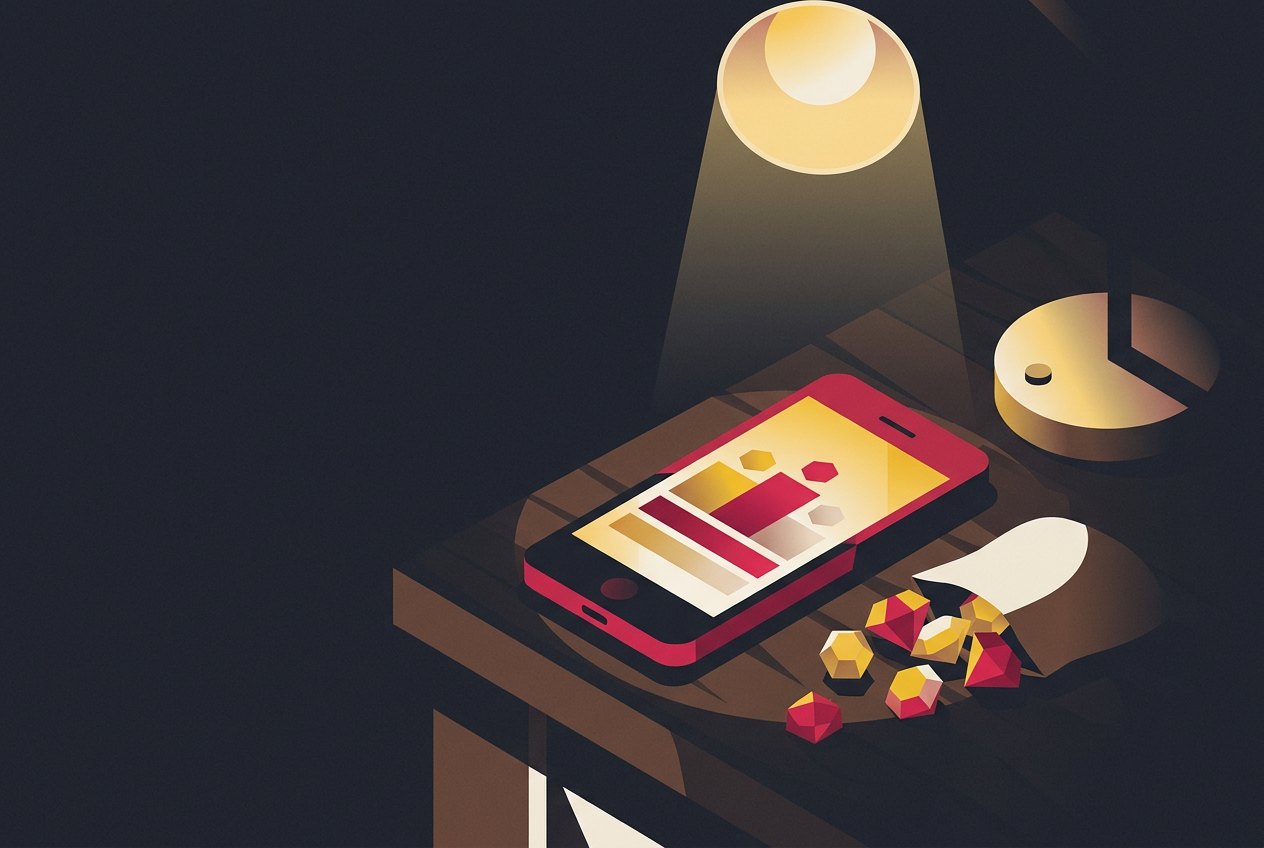
On November 6, 2026, YouTube let viewers in 9 countries buy extra Hype with Jewels, the platform's in-app currency. Until then Hype worked like this: 3 free votes per viewer per week, and that was it. Now money can break through that limit, and the video's creator gets a share of every purchase. Below I break down what exactly changed, who it affects, how to turn the feature on in YouTube Studio, and why I wouldn't spend my own money on Hype instead of ads.
What YouTube changed on November 6, 2026 and where it works
The change was announced in a pinned TeamYouTube post in the YouTube Help Community, the platform's official support forum. Paid Hype opened to viewers in 9 countries: the US, Canada, Germany, Ireland, Italy, Poland, Spain, Turkey and the UK.
Before that, the feature already worked in Brazil, South Korea, Taiwan and Japan. YouTube didn't say when it launched there. That makes 13 countries in total where the Hype leaderboard, originally built on free votes, now takes paid ones too.
The mechanics are simple. A viewer has used up their 3 free Hypes for the week, but still likes the video. Before, that was the end of it. Now the button stays active, only this time they press it with Jewels.
How Hype worked before the paid version
Hype appeared in 2024 as a way for small channels to get in front of new viewers. Each viewer could Hype eligible videos up to 3 times a week, and only in the first 7 days after upload. Votes added up into a country-level Hype leaderboard, which shows which fresh videos viewers themselves are pushing right now.
At the same time YouTube separated Hype from the recommendation algorithm. Hype lifted a video in a separate leaderboard, while the recommendation feed, according to the platform, ran on its own rules. The point was to stop voting from becoming a way to hack the feed.
In July 2025 YouTube shut down the Trending page. As replacements for discovering new videos, it named category charts and that same Hype. From then on, the Hype leaderboard became one of the few showcases a small channel can get into at all.
By fall 2026 the scale was serious. At Made on YouTube on September 23, 2026, the platform gave a figure: over 1 billion Hypes across 75 million videos. Divide that and you get roughly 13 Hypes per video on average. Not much. That's exactly why every extra vote on the leaderboard matters. At the same event, paid Hype was presented as the next step.
What changed: paid Hype, Jewels and Rubies
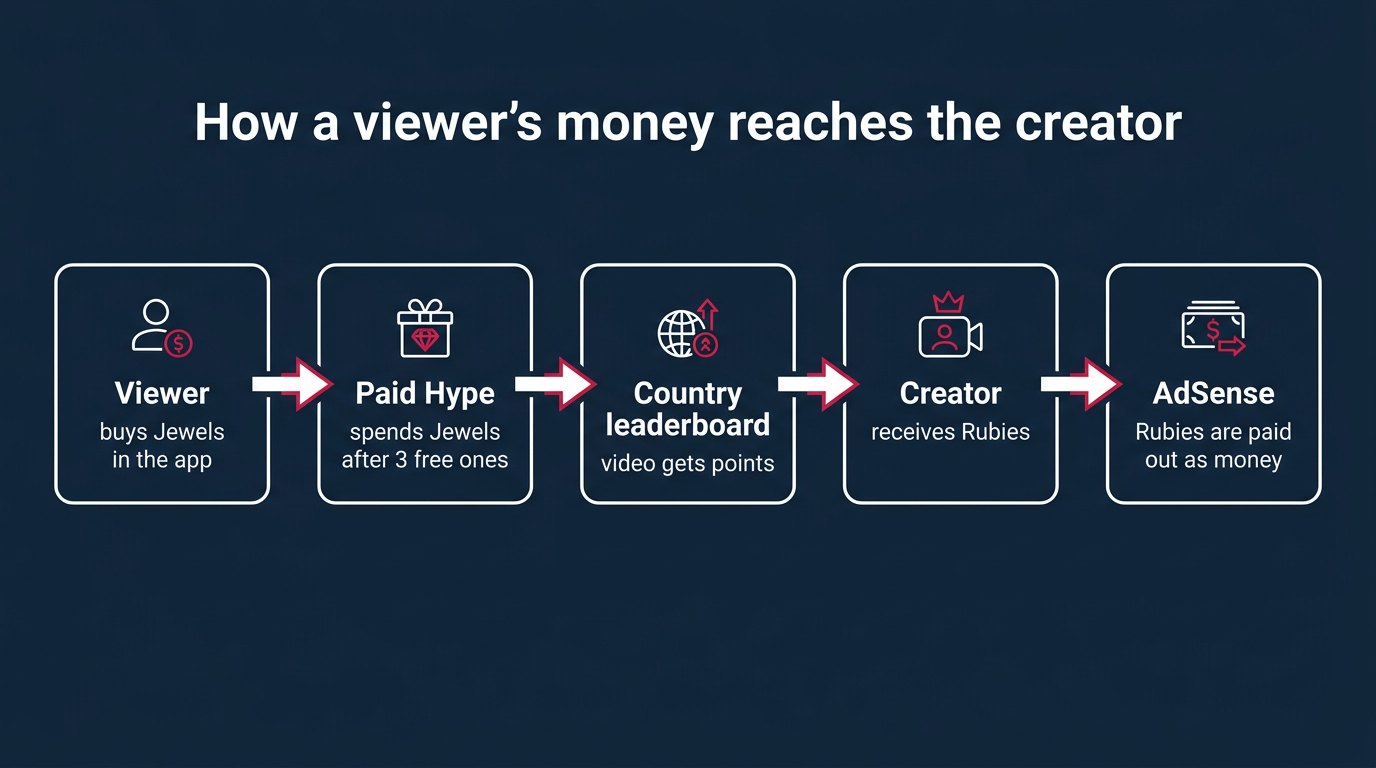
The weekly limit of 3 free Hypes stays. But it's no longer a ceiling. After that, a chain of two currencies kicks in, and it's worth understanding once so you don't get confused later.
- Jewels: the currency a viewer buys with real money. It was already used to pay for gifts in livestreams.
- Paid Hype: a viewer spends Jewels, and the video gets points on the country leaderboard.
- Rubies: the currency the creator receives from each such purchase.
- AdSense: Google's ad account, through which YouTube pays out Rubies to the creator as real money.
How many Jewels one Hype costs and how many Rubies the creator gets from it, the TeamYouTube post doesn't say. It explicitly states that pack prices and the number of Jewels per Hype may change. There's no single price in the rules, and that's the biggest hole in the whole story.
How much paid Hype costs: a benchmark from Japan
Japan has lived with paid Hype longer, so all benchmarks come from there. Jewels are sold in 6 packs: from 160 yen for 50 Jewels to 38,800 yen for 20,000 Jewels. So one Jewel costs 3.2 yen in the smallest pack and 1.94 yen in the largest. That's a 1.6x difference in favor of the big purchase.
Paid Hype gives a 5x or 10x multiplier versus 1x for a free one. So one paid press weighs as much as 5 or 10 free votes. One Japanese user calculated that a Hype costs 300 Jewels, regardless of how many times you've repeated it.
Taking his 300 Jewels, it works out like this:
- in the small pack, 300 Jewels cost 960 yen;
- in the large pack, the same 300 Jewels cost 582 yen;
- in dollars that's about $6.06 and $3.67 at 158.51 yen per $1 on November 7, 2026, according to Macrotrends.
What the creator gets, I calculate using the only known rate. For livestream gifts it's this: 2 Jewels give the creator 1 Ruby, and 1 Ruby equals $0.01. If the rate is the same for Hype, 300 Jewels bring the creator 150 Rubies, or $1.50. This is only a benchmark: YouTube hasn't disclosed the rate for Hype.
That leads to a question Japanese viewers ask: which is better, Hype or a livestream gift. I'll calculate on the same 300 Jewels. A livestream gift at 2 Jewels per Ruby gives the creator 150 Rubies, which is $1.50. A Hype for the same 300 Jewels, if the rate is the same, brings the creator the same amount. But on top of that, the video gets points on the country leaderboard with a 5x or 10x multiplier. A gift has no such bonus.
They also differ in timing. A gift only works during a live stream: once the stream ends, there's nothing to gift. Hype only works on videos no older than 7 days. An important caveat: YouTube hasn't disclosed the Ruby rate for Hype, so the whole conclusion is conditional and rests on the assumption that the rate matches the gift rate.
With that caveat, my position is simple. If a viewer wants to support a channel with both money and reach, Hype is, all else equal, a better deal than a gift. The creator gets the same money, and the video also rises on the country leaderboard. A gift makes sense when the creator is live right now and the in-the-moment reaction matters. In every other case I'd spend Jewels on Hyping a fresh video.
Who this affects and who it doesn't
There are lots of conditions here, and each one cuts someone out. I put it all into one table.
| Who | Paid Hype | Why |
|---|---|---|
| Channel in YPP, 500-500,000 subscribers | Yes | Fits the window under the rules |
| Channel with over 500,000 subscribers | No | Hype is designed for small channels |
| Channel not in YPP | No | Can't accept Jewels without the Partner Program |
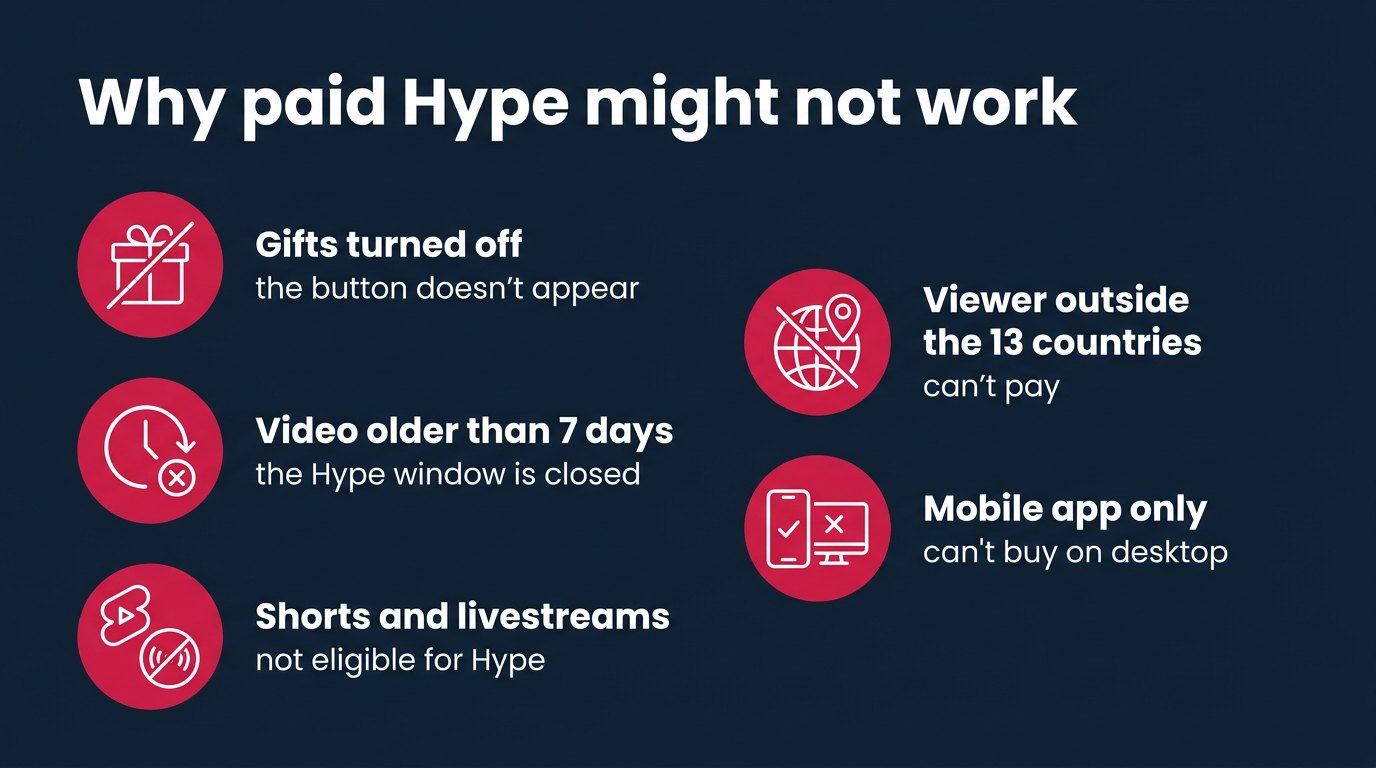
| Channel with gifts turned off | No | The extra Hype button doesn't appear |
| Video older than 7 days | No | The Hype window is closed |
| Shorts, private videos, ongoing livestreams | No | Not eligible even for regular Hype |
| Viewer outside the 13 countries | No | Only viewers in supported countries can pay |
YPP, the YouTube Partner Program, gives a channel access to monetization. The 500-500,000 subscriber limit comes from the same pinned TeamYouTube post.
An important detail about gifts being turned off. Users in Japan noticed: if gifts aren't enabled on a channel, the viewer simply has no extra Hype button. No error, no hint. The viewer presses, the free ones are used up, and then nothing. Meanwhile the creator may not even know they're losing votes.
One more detail on the viewer side. Jewels can be bought in the YouTube mobile app. On desktop, judging by user reports, you can't. If the core of your audience watches on a TV or laptop, they'll have to reach for their phone. An extra step, and every extra step cuts conversion.
How to turn on paid Hype in YouTube Studio, step by step
The order is based on the English help pages and breakdowns by Japanese creators. Menu names may differ slightly depending on your interface language.
- Check that the channel is in YPP. YouTube Studio, the "Earn" section. If it offers you to apply, the channel isn't in the program, and there's nowhere further to go.
- Check your subscriber count. You need between 500 and 500,000. It's visible on the Studio dashboard.
- In the "Earn" section, find the Virtual Items module. Open it and accept the Virtual Items Terms. Without this step the channel doesn't accept Jewels.
- Turn on gifts. Remember the observation from Japan: with gifts turned off, the paid Hype button doesn't appear.
- Check your viewers' geography: "Analytics", the "Audience" tab, the top countries block. If none of the 13 countries are there, there's no one to pay you.
- Make a test purchase. Japanese creators suggest asking a friend in a supported country to buy one Hype from their phone on a fresh video, under 7 days old. That shows the button works and the purchase goes through.
- Check that Rubies arrived. "Analytics", the "Revenue" tab, the list of revenue sources. A line for virtual items or gifts should appear there. Payout goes through AdSense along with the rest of the channel's income.
If there's no button at step 6, go back to steps 3 and 4. Based on Japanese users' experience, the cause is almost always gifts being turned off.
What a paying viewer gets
A purchased Hype adds points to the video on the country leaderboard. There's also a bonus: if a viewer spent Jewels while the video was Hype-eligible and they're in a supported country, their handle may appear in a thank-you block in the video description. A handle is the account name with the @ sign.
Notice the word "may". There's no guarantee. In discussions you'll find both versions: that the handle stays forever, and that it doesn't always appear. I wouldn't promise fans "your name will be in the description".
What the purchase doesn't give, YouTube listed directly. No rights to the video. No channel membership, meaning the paid subscription with badges and perks. And no guarantee that other viewers will see the video. That last point matters most: money moves a video on the leaderboard but doesn't promise views.
A worked example: a channel with 40,000 subscribers
Take a hypothetical channel. 40,000 subscribers, in YPP, main audience in Germany and Poland. A core of 200 people reliably Hypes every new video.
Free. 200 people with 3 Hypes each, weight 1x: that's 600 units per week. That's the ceiling of the old system. You can't collect more without new viewers.
Now 20 of those 200 people buy one paid Hype each. With a 10x multiplier that adds 200 units, with 5x another 100. Total: 700-800 units instead of 600, a 17-33% increase thanks to 10% of the core.
What it costs the fans. 20 Hypes at 300 Jewels each come to 6,000 Jewels. At Japanese prices that's from 11,640 yen if everyone bought the large pack, up to 19,200 yen with small ones. What the creator gets: 6,000 Jewels at the gift rate give 3,000 Rubies, which is $30.
The gap between what fans paid and what reached the creator is big. That's the platform's cut, and it's undisclosed. But for the creator, that $30 came out of nowhere: he spent nothing, just ticked a box in Studio.
Why I wouldn't buy Hype myself instead of ads
The temptation is clear. A creator with 30,000 subscribers sees: you can pay, and the video rises on the country leaderboard. Sounds like advertising, only cheaper. It isn't cheaper.
- The price is hidden. YouTube says outright that the number of Jewels per Hype may change. Planning a budget on a number the platform doesn't promise to keep is guesswork. With Google Ads you at least see what each impression cost.
- The leaderboard is weekly, and a video is Hype-eligible for only 7 days. You buy a spot, and a week later it's gone. The purchase doesn't guarantee views, YouTube noted that separately. With video ads you pay for the video actually being shown.
- There's the math. The same 11,640 yen from the example above is about $73 at 158.51 yen to the dollar. According to Stackmatix estimates for August 2026, a skippable In-Stream ad view costs on average $0.03 to $0.12, and you only pay if the viewer watched 30 seconds or clicked. So for that money a creator gets roughly 600 to 2,400 paid views. From his own Hype, he gets part of his own money back through Rubies, minus the platform's cut. Cycling money through a commission just to sit on a leaderboard for a week makes no sense to me.
My approach is this. Turn the feature on, because it's free for the creator and can bring in money and points. Don't buy it yourself. Put your promotion budget, if you have one, into ads where you see the price and the result. If you need it, I'll run the numbers for your case, write to support.
How to ask viewers to Hype without looking like a beggar
The main value of this change isn't the money. It's that your core audience now has a way to help the channel more than 3 presses a week. But it only works in the first 7 days after a video goes live. So that's exactly when you need to ask.
Here's how I'd do it:
- In the first 2-3 minutes of the video, not at the end, say that the video can be Hyped for a week and that this lifts it on the country leaderboard.
- Mention free Hypes specifically. First the 3 free ones, paid ones only after that and without pressure. Most people don't even use the free ones.
- Pin a comment with the same request on release day.
- After 3-4 days, remind people in the channel's Community tab or in Telegram or Discord, if you have one. The window is still open.
- Don't promise a handle in the description. YouTube says "may appear", nothing more.
Asking your viewers for money in plain words is risky. A person came for a video, and you're selling them a button. So put the emphasis on the free part: whoever wants to pay will find the button themselves.
What to do if your viewers aren't in the 13 countries
For example, if your main audience is in India, Mexico or Indonesia. They're not on the list. Viewers there can't buy paid Hype, even if the channel meets every other condition.
What you can do:
- Open "Analytics", the "Audience" tab, and check what share of viewers comes from the 13 countries. Sometimes 10-15% of the audience lives in Germany, Poland or Turkey, and the creator simply forgets.
- If there is such a share, turn the feature on anyway. It costs nothing, and those who can will pay.
- If there isn't, don't count on paid Hype. It's not your button. Better to put your effort into what works for any geography: thumbnails, the first 30 seconds of the video, consistency.
- Keep an eye on the country list. On November 6, 2026 it grew from 4 to 13 in one step. Another expansion is quite possible, and it's better to be ready for it in advance.
Pitfalls of paid Hype
I collected the things you can trip over.
- Gifts are off. There's no extra Hype button, and the creator doesn't know it. Check with a test purchase.
- Video older than 7 days. The window has closed, asking is pointless. All work with the audience has to fit into the first week.
- Shorts aren't eligible. If a channel lives on short videos, paid Hype barely affects it.
- The price floats. The 300 Jewels figure from Japan is one person's observation, not a price list.
- The Ruby rate for Hype is unknown. The only official rate is for livestream gifts: 2 Jewels per 1 Ruby.
- Purchases are phone-only. Viewers on desktop drop out immediately.
- The 500,000 subscriber cap. The channel grows, the feature switches off. Here growth means losing Hype income.
The YPP threshold from February 1, 2027: why timing matters
No Partner Program, no paid Hype. And getting into the program is getting harder. From February 1, 2027, YPP requirements double: 8,000 watch hours or 20 million Shorts views.
According to AIR Media-Tech partner support, applications submitted before 23:59 UTC on January 31, 2027 are evaluated under the current requirements. That means 4,000 hours or 10 million Shorts views.
If your channel is close to the current threshold, apply before January 31. After February 1, entry becomes twice as hard, which means the 500-500,000 subscriber window with Hype money will also get narrower for new creators.
Where paid Hype goes from here
An open question YouTube hasn't answered: does the separation between Hype and recommendations introduced in 2024 still hold now that money is involved. If the leaderboard stays a separate showcase, paid Hype is a donation with a visible effect. If even part of the signal leaks into recommendations, it's already buying reach.
A columnist on dev.to sees it this way: paid Hype normalizes paying for reach. Visibility on the leaderboard used to be earned with votes, now you can top it up. Hard to argue with that. A leaderboard where 10% of fans provide up to a third of the points is no longer a clean vote.
My predictions, and the arguments for them:
- There will be more countries. In one step on November 6, 2026, the list grew from 4 to 13, including the US and the UK. Those are YouTube's highest-paying markets, so further expansion after them looks logical.
- The leaderboard will tilt toward channels with audiences that have money. A 5x-10x multiplier gives a small but wealthy core an edge over a large but poorer one.
- There will be attempts to game the leaderboard by buying Hype. With 13 Hypes per video on average, per Made on YouTube data, a position can be shifted with small money. But the price is hidden and changes, and the leaderboard lasts a week. Whether such schemes pay off is a big question.
What definitely hasn't changed: the purchase doesn't guarantee views. YouTube wrote that itself. Everything else will become clear from how the leaderboard behaves in the first months.
Questions
Hype is a viewer's vote for a fresh video, and it lifts the video on the country Hype leaderboard. For free, each viewer can Hype up to 3 times a week, and only videos no older than 7 days. Since November 6, 2026, in 13 countries you can Hype beyond the limit with Jewels.
There's no official price, YouTube stated that the number of Jewels per Hype may change. In Japan, one user counted 300 Jewels per Hype. Jewels there cost from 160 yen for 50 to 38,800 yen for 20,000.
The creator receives Rubies, which YouTube pays out through AdSense. The rate specifically for Hype hasn't been disclosed. For livestream gifts, 2 Jewels give 1 Ruby, and 1 Ruby equals $0.01. At that rate, a 300 Jewel Hype would bring the creator $1.50.
Most often, gifts are turned off on the channel or the Virtual Items terms haven't been accepted in YouTube Studio. Other reasons: the video is older than 7 days, it's a Short or an ongoing livestream, the channel has over 500,000 subscribers, the viewer isn't in the 13 countries, or they're on desktop rather than a phone.
13 countries: Brazil, South Korea, Taiwan and Japan, where it appeared earlier, plus the US, Canada, Germany, Ireland, Italy, Poland, Spain, Turkey and the UK since November 6, 2026.
YouTube hasn't said. Since 2024, Hype and the recommendation algorithm have been separate, but whether that separation holds with paid votes, the platform didn't say. The purchase itself, according to YouTube, doesn't guarantee that other viewers will see the video.
No. The price is hidden and may change, the leaderboard is weekly, and the purchase doesn't guarantee views. Promotion money is better spent on ads, where you can see the price per view.
What to do
- Open YouTube Studio, the "Earn" section, accept the Virtual Items terms and turn on gifts.
- Check in "Analytics" what share of viewers comes from the 13 countries. If there isn't one, paid Hype isn't your button.
- Ask a friend in a supported country to buy one Hype on a fresh video from their phone, and check that Rubies showed up in the "Revenue" tab.
- In every new video, in the first minutes, ask your core audience to Hype it while the 7 days haven't passed.
- If your channel is approaching the YPP threshold, apply before 23:59 UTC on January 31, 2027.
Writes about: SMM, paid boosts, ads, traffic, suppliers, the market from the inside, daily news